⚠️ Chemical Safety Notice & Disclaimer
For Informational Purposes Only. Pool chemical dosing carries inherent risks of severe injury, toxic gas release, and property damage. The calculations and instructions provided here are for general educational purposes and do not replace chemical labels, manufacturer instructions, or professional certified pool operator guidelines.
By utilizing this data, you assume all risk of liability. Always wear appropriate PPE and never mix chemicals. See Terms of Service.
How to Balance Alkalinity Like a CPO
In my CPO courses, I see it all the time: students overlook Total Alkalinity, assuming it's just an extra box to check on their log sheet. What they quickly learn is that TA is critical in its own right. Think of alkalinity as your pool’s built-in insurance policy. It measures the water's ability to resist pH shifts. If your TA isn't balanced, your pH will swing all over the place—costing you time, money, and frustration. Master TA first, and managing your pool chemistry becomes tenfold easier.
The Pool & Hot Tub Alliance (PHTA) establishes the ideal baseline for alkalinity between 80 to 120 parts per million (ppm). Keeping your water in this sweet spot prevents aggressive pH shifts, protects expensive plaster and heaters, and ensures your chlorine sanitizes at peak efficiency.
1. The Right Way to Test
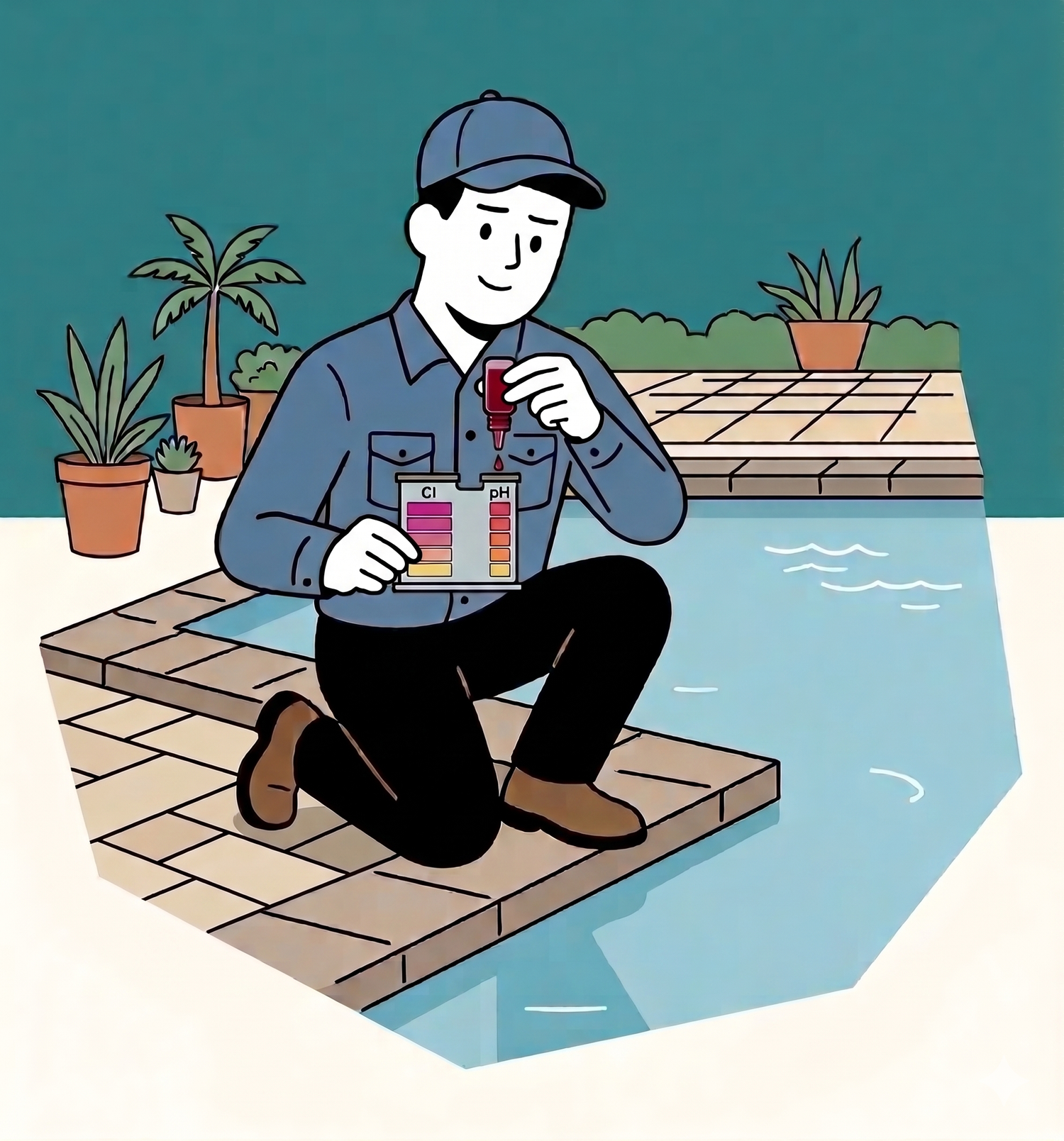
To control alkalinity, you have to test it with precision. While test strips give quick ballpark figures, commercial drop-test kits utilize a titration method (adding reagent drops until a distinct color change occurs) to give you an exact ppm reading.
The Testing Sequence:
- Rinse and Fill: Rinse your test cell with pool water. Fill the sample tube precisely to the required mark (typically 25 mL for most standard commercial kits).
- Add the Indicator: Add the specified number of drops of your alkalinity indicator reagent (often turns the water green or blue). Swirl gently to mix.
- Count the Drops: Add your sulfuric acid titrant reagent drop by drop. Swirl after every single drop and keep a strict count.
- Spot the Endpoint: Watch for the exact moment the water shifts completely from its initial color to a distinct pink, red, or yellow (depending on your kit brand).
- Calculate: Multiply the total number of drops it took to reach that color shift by the multiplier specified in your kit manual (usually 10 ppm per drop).
2. The Golden Rule: Balance TA Before pH
If both your pH and your Total Alkalinity are out of balance, always adjust the Total Alkalinity first. Trying to fix your pH while your alkalinity is out of whack is an exercise in futility.
- If you try to fix pH when TA is too low: The water lacks any buffering capacity. The second your pH chemical hits the water, the pH will completely overshoot your target and "bounce" straight into the opposite danger zone.
- If you try to fix pH when TA is too high: The water is over-buffered (pH lock). Your standard doses of muriatic acid will be instantly neutralized by the heavy alkalinity, rendering your pH adjustments completely ineffective. You will waste expensive chemicals and time.
Think of it this way: Total Alkalinity is the foundation, and pH is the house. You must stabilize the foundation before you can successfully build the house.
Want to move past basic pool troubleshooting? Level up your career and your water chemistry knowledge with our industry-recognized CPO course.
3. The Two Extremes: pH Bounce vs. pH Lock
When your Total Alkalinity strays outside the ideal 80–120 ppm window, it destabilizes your pool's chemistry in one of two ways.
Low Alkalinity (< 80 ppm) = pH Bounce
- When alkalinity drops too low, your water loses its shock absorber. Because there is no chemical buffer to absorb small environmental changes (like rainfall, swimmer splash-out, or adding normal sanitizer), your pH becomes incredibly erratic. Adding a tiny bit of acid can cause the pH to plummet to dangerously corrosive levels, while adding chlorine might instantly rocket it up. This rapid, unpredictable swinging back and forth is pH bounce.
High Alkalinity (> 180 ppm) = pH Lock
- Conversely, when TA climbs too high, it creates pH lock. Because there is a massive over-abundance of chemical buffers, the water stubbornly resists any downward movement. Your pH will likely lock in at a high, basic level (around 7.8 to 8.2 or higher). If you attempt to add normal amounts of muriatic acid to bring the pH down to an ideal 7.4, the over-buffered water will neutralize the acid instantly, causing the pH to barely budge.
Leaving a pool in pH lock leads to highly scale-forming water, cloudy visibility, clogged filters, and severely reduced chlorine effectiveness. To break pH lock, you cannot focus on the pH directly; you must aggressively lower the Total Alkalinity first.
4. Practical Dosing Logic
Once you have your true ppm number, balancing your water comes down to basic math and strategic chemical additions.
To Raise Total Alkalinity & Stop pH Bounce
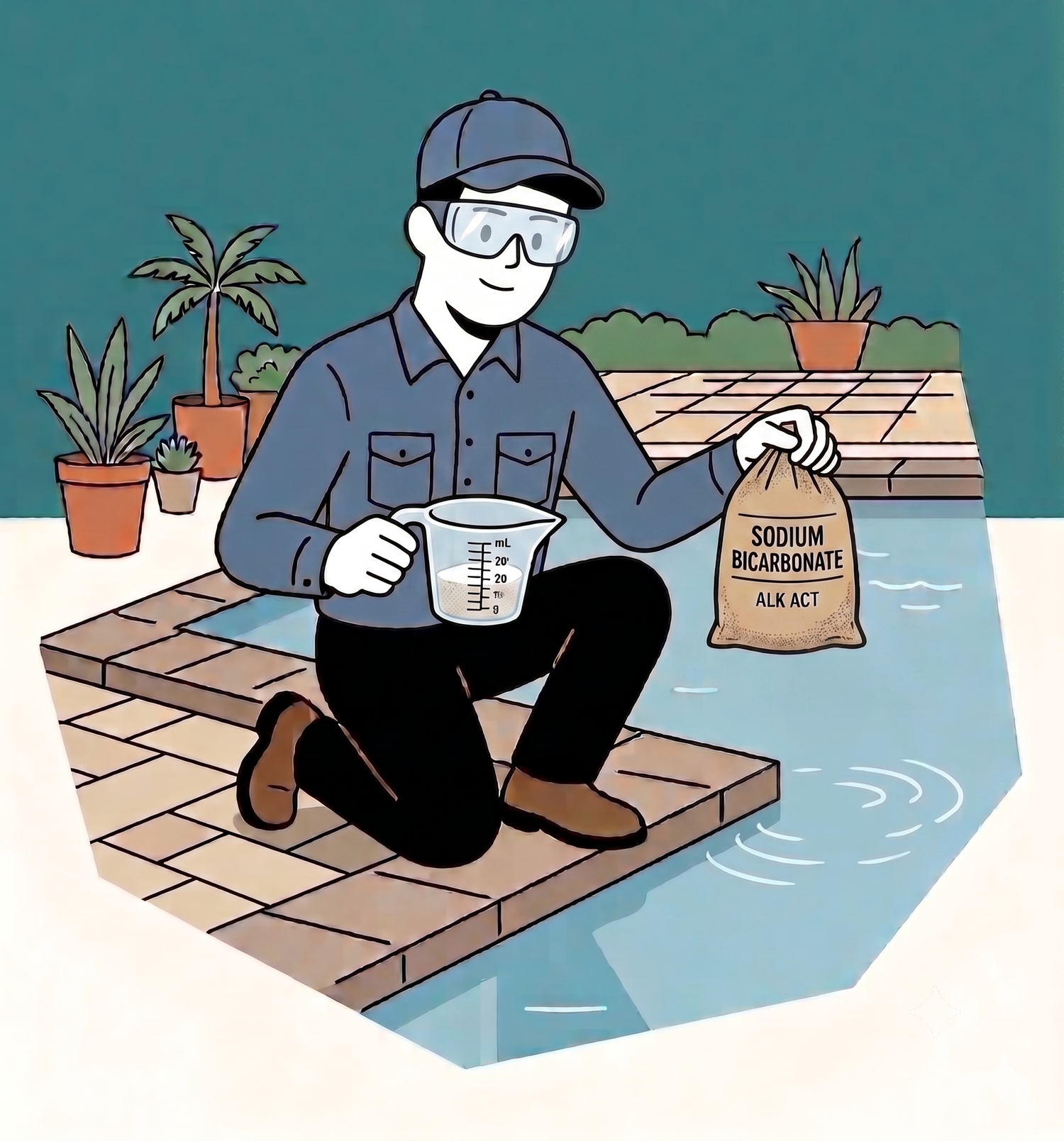
Low alkalinity causes etched plaster, corroded metal components, and a rapidly dipping pH. To bring it up safely, use Sodium Bicarbonate (Baking Soda). It is highly soluble, safe to handle, and targeted specifically at raising alkalinity without violently forcing your pH through the roof.
The Rule of Thumb: To raise TA by 10 ppm in a 10,000-gallon pool, you need 1.4 pounds of Sodium Bicarbonate.
- Application: Broadcast the powder evenly over the deep end of the pool with the pump running. Never dump it all in one spot, or it can cloud the water.
To Lower Total Alkalinity & Break pH Lock
To pull your water out of pH lock and lower the TA, you use Muriatic Acid (Liquid).
The Rule of Thumb: To lower TA by 10 ppm in a 10,000-gallon pool, you need roughly 26 fluid ounces of Muriatic Acid (31.45% strength).
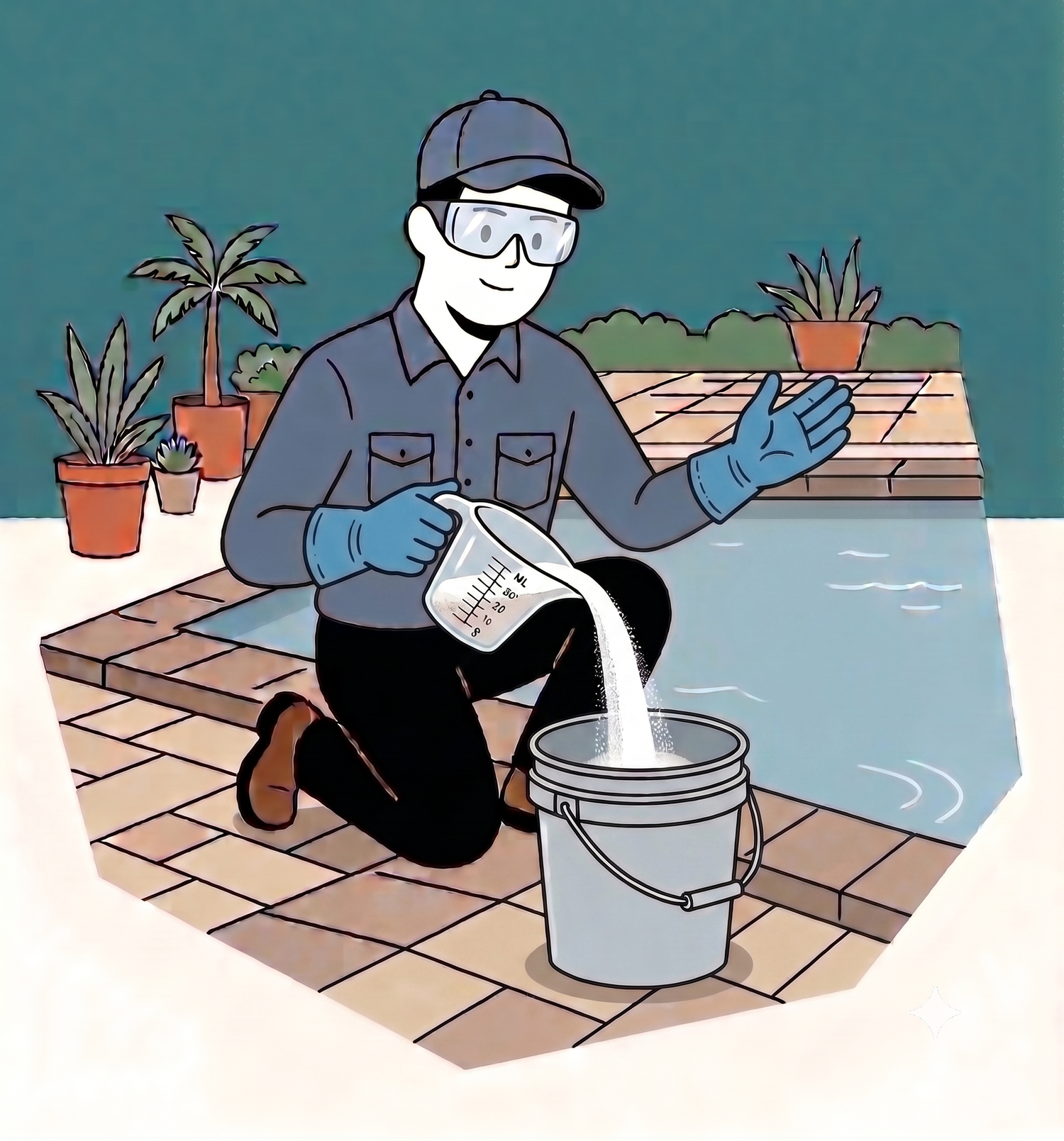
- Application: Always dilute the acid in a bucket of pool water first, then pour it evenly around the perimeter of the deep end with the pump running.
Knowing how to fix alkalinity makes you a good tech. Getting CPO certified makes you an indispensable professional.
Explore our upcoming course dates here.
Important Safety Reminders:
- Read the SDS: Always consult the Safety Data Sheet (SDS) and manufacturer label instructions for every chemical before opening the container.
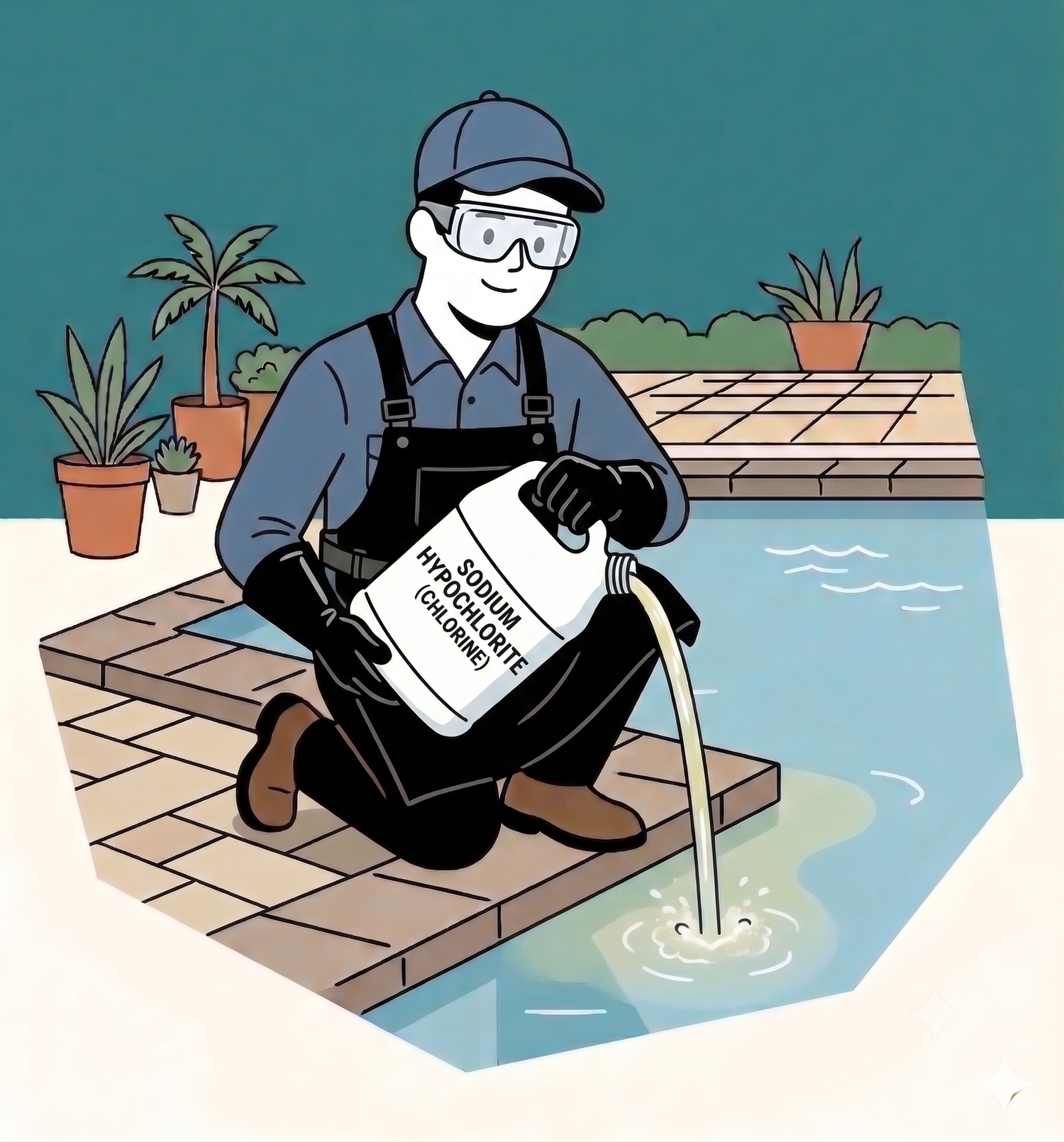
- Personal Protective Equipment (PPE): Always wear appropriate PPE, including chemical-resistant gloves, safety goggles, and respiratory protection where required.
- Never Mix Chemicals: Never mix different dry chemicals together, and never mix different types of chlorine (e.g., mixing Trichlor tablets with Cal-Hypo can cause a violent explosion).
- Always Add Chemical to water: When diluting chemicals, Always Add Acid (or chemical) to water—never add water to chemical.
- Local Regulations: Commercial pool operators must ensure all chemical adjustments comply with local, state, and federal health codes.