⚠️ Chemical Safety Notice & Disclaimer
For Informational Purposes Only. Pool chemical dosing carries inherent risks of severe injury, toxic gas release, and property damage. The calculations and instructions provided here are for general educational purposes and do not replace chemical labels, manufacturer instructions, or professional certified pool operator guidelines.
By utilizing this data, you assume all risk of liability. Always wear appropriate PPE and never mix chemicals. See Terms of Service.
How to Balance Calcium Hardness Like a CPO
When managing commercial or residential pools, Certified Pool Operators (CPOs) look at water balance through a strict mathematical lens. Among the key parameters taught in the PHTA (Pool & Hot Tub Alliance) CPO Certification Course, Calcium Hardness (CH) is one of the most critical—and in my experience as CPO Instructor, one of the most frequently misunderstood.
Calcium Hardness specifically tracks the concentration of dissolved calcium minerals in the water. Getting this level right is the difference between a pristine, long-lasting pool facility and thousands of dollars in structural damage.
The Crucial Balance: Why Calcium Hardness Matters
Pool water is hungry. If it lacks minerals, it will aggressively seek them out from its environment. Conversely, if it is oversaturated with minerals, it will look for any opportunity to drop them out of solution.
- Low Calcium Hardness (Aggressive Water): When water drops below the minimum threshold, it becomes corrosive. It will literally leach calcium right out of plaster, pebble, grout, and concrete surfaces. This leads to severe pitting, etching, and structural weakening. It can also degrade metal components like heat exchangers.
- High Calcium Hardness (Scaling Water): When the water is oversaturated with calcium, the excess minerals precipitate out. This manifests as rough, white calcium scale on pool walls, clogged filtration media, and narrowed plumbing lines. It also causes chronic water cloudiness that is highly resistant to standard clarifiers.
The PHTA Ideal Ranges
According to PHTA standards, the required levels vary slightly depending on the specific finish of your pool, but the baseline parameters are tightly defined:
| Metric Level | Minimum Limit | Ideal Range | Maximum Limit |
|---|---|---|---|
| PPM Level | 150 ppm | 200 – 400 ppm | 1,000 ppm (Action required) |
Note: For pools with vinyl liners or fiberglass structures, the lower end of the ideal range (around 150-250 ppm) is often targeted because there is no plaster to leach from. However, concrete and plastered commercial pools should aim closer to 250-350 ppm to properly protect the exposed masonry.
Dosing: How to Adjust Your Calcium Levels
- Raising Calcium Hardness - If your test kit reveals that your calcium hardness is low, you need to add Calcium Chloride to the pool. It is typically sold in two forms: Flake (usually 77% strength) or Granular/Pellet (usually 94-100% strength).
The CPO standard dosing math relies on a simple rule of thumb for a 10,000-gallon pool. To raise Calcium Hardness by 10 ppm in a 10,000-gallon pool, you must add .9lb of 100% (or 94% anhydrous) Calcium Chloride pellets.
If you are using 77% calcium chloride flakes, you must account for the lower concentration by adding roughly 1.2 pounds per 10,000 gallons for that same 10 ppm bump.
How to Dose Safely:
Calcium chloride creates an exothermic reaction when mixed with water—meaning it generates significant heat.
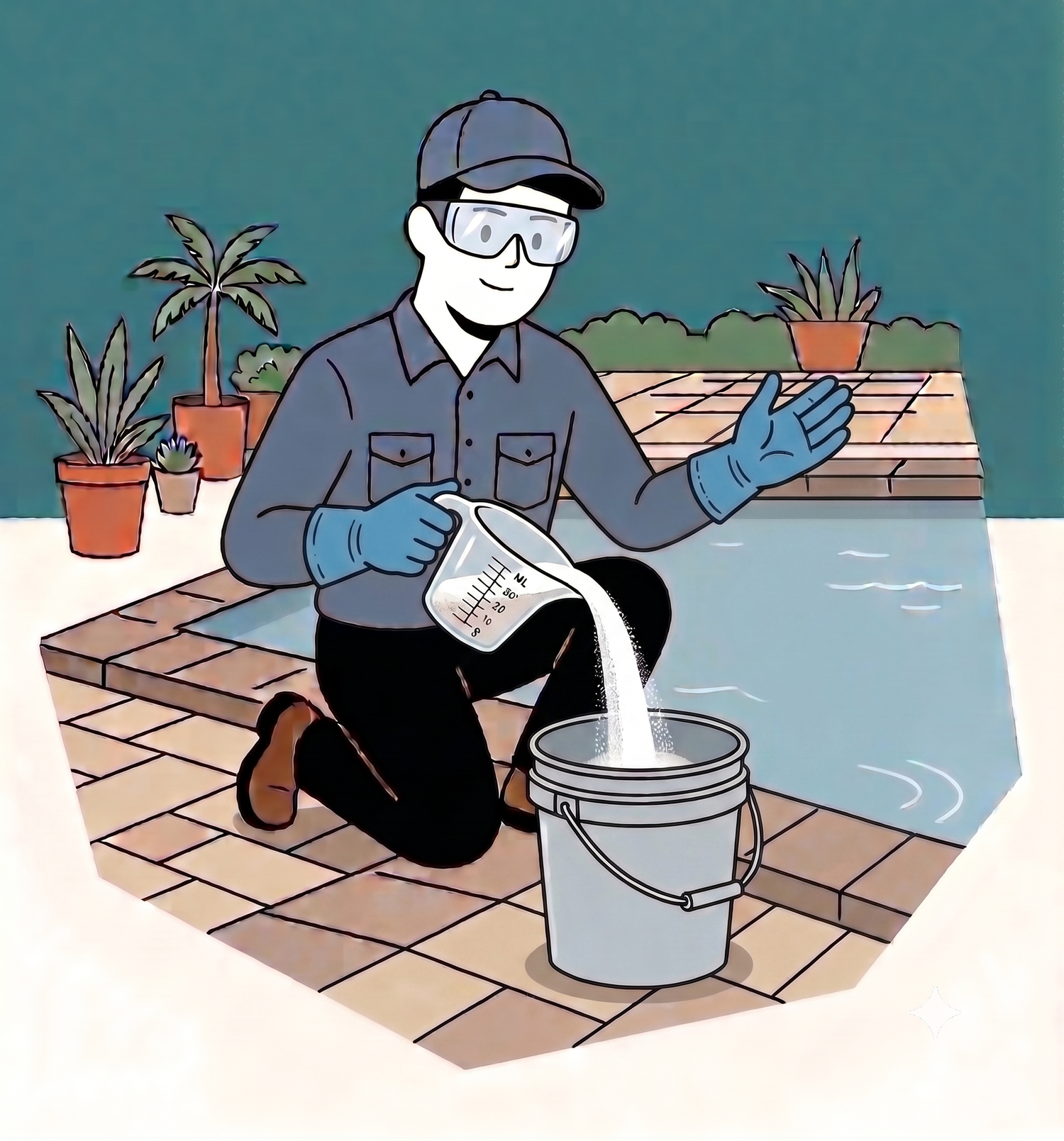
- Always fill a bucket with water first, then slowly add the chemical to the water (never add water to dry chemical).
- Stir thoroughly until fully dissolved, allowing the pre-dissolved solution to cool slightly.
- Broadcast the slurry evenly around the deep end of the pool with the pump running.
Alternative Method: Raising Calcium using Cal-Hypo
While calcium chloride is the primary chemical used for intentional, large-scale adjustments, you can also raise your calcium levels incrementally through your choice of daily sanitizer.
Calcium Hypochlorite (Cal-Hypo) is a highly popular, fast-acting chlorine shock. Because it is bound to calcium, every pound of Cal-Hypo you add to sanitize the pool leaves behind a small footprint of calcium hardness.
The Cal-Hypo Rule of Thumb: In a 10,000-gallon pool, adding 1 pound of 65% strength Calcium Hypochlorite will automatically raise your Calcium Hardness by roughly 5-7 ppm.
While this is an efficient "two-for-one" strategy for pools with naturally soft water, it requires careful monitoring. If your pool is already sitting at the upper end of the PHTA ideal range (near 400 ppm), continuous use of Cal-Hypo can inadvertently push your water into the scaling zone.
Want to master the hidden variables of pool sanitizers? Sign up for a Virtual CPO Certification Course today and learn how to manage your daily chemical routine like a true pro.
Lowering Calcium Hardness
CPOs utilize three primary strategies to manage high calcium levels:
- Drain and Dilute: If your fill water has a lower calcium level than the pool water, partially draining the pool and refilling it is the most straightforward remedy. However, this may not be viable in areas with strict water restrictions or drought conditions.
- Reverse Osmosis (RO) Water Filtration: Instead of wasting thousands of gallons of water via draining, you can hire a specialized mobile Reverse Osmosis company. These companies bring high-pressure RO filtration trailers directly to the facility. They pump the pool water through tightly woven membranes that strip away dissolved calcium, cyanuric acid (CYA), and total dissolved solids (TDS), returning purified, perfectly balanced water right back into the pool.
- The Langelier Saturation Index (LSI): Experienced operators know that high calcium doesn't always equal instant scaling. This is something that is new to many of my students, but understanding it you separate yourself as a true professional. By lowering the water's pH or Total Alkalinity slightly, you can manipulate the LSI to keep even high levels of calcium completely dissolved in the water without precipitating out. Safely manipulating these delicate chemical balances is one of the most critical skills you'll master in our online CPO Certification training.
⚠️ Operator Disclaimer: Balancing your LSI is a highly effective way to prevent active scaling when calcium levels are elevated. However, you must always cross-reference your test results with your local board of health codes. Even if your LSI math is perfectly balanced, many jurisdictions enforce a hard legal maximum limit on calcium hardness. If your pool exceeds local code limits, you must take active steps to lower it regardless of your LSI score to remain compliant.
Important Safety Reminders:
- Read the SDS: Always consult the Safety Data Sheet (SDS) and manufacturer label instructions for every chemical before opening the container.
- Personal Protective Equipment (PPE): Always wear appropriate PPE, including chemical-resistant gloves, safety goggles, and respiratory protection where required.
- Never Mix Chemicals: Never mix different dry chemicals together, and never mix different types of chlorine (e.g., mixing Trichlor tablets with Cal-Hypo can cause a violent explosion).
- Always Add Chemical to water: When diluting chemicals, Always Add Acid (or chemical) to water—never add water to chemical.
- Local Regulations: Commercial pool operators must ensure all chemical adjustments comply with local, state, and federal health codes.